

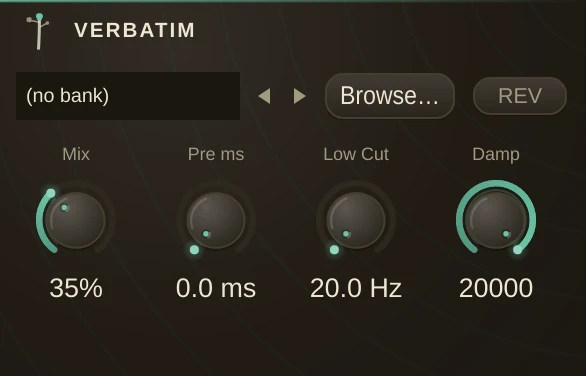
The convolution reverb: it quotes a real place word for word. Point it at an impulse response - a recording of how a room answers a single clap - and everything you play happens inside that room, repeated verbatim. A stone stairwell, a spring tank, a cathedral, a drainpipe: whatever the file holds becomes the space. Any ordinary audio file works as the impulse; the ones made for the purpose simply sound like rooms rather than notes.
Loading a space
Drop or pick the file in the strip at the top. The room is cooked on a swapped in cleanly, so loading never interrupts the sound. Loudness is normalised on the way in, which keeps wildly different files at a comparable level - the Mix knob stays meaningful when you audition a folder of rooms.
Parameters
| Mix | dry against wet, equal-power. Full left is the untouched signal, bit-exact; full right is only the room. |
| Pre ms | predelay: the wet signal waits up to a quarter second before it answers, pushing the room back behind the direct sound. |
| Low Cut | trims the wet low end, where long rooms turn to mud. At its minimum it only steadies the very bottom. |
| Damp | a high shelf-off on the wet path. Pull it down and the room's answer darkens, as if the walls grew softer. |
| REV | plays the impulse backwards - the room breathes in instead of out. Swells that rise into the note, the classic reverse trick. |