

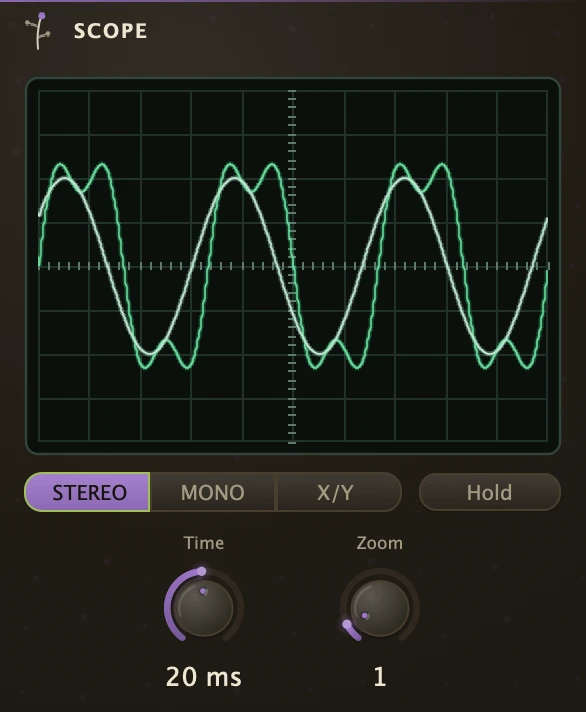
An oscilloscope with a glowing green trace, in the tradition of the bench instrument, passing the audio through untouched.
The screen shows the wave itself: time runs across, level runs up, and the centre line is silence. Every sweep starts where the wave rises through the centre line, so a steady pitch stands still instead of sliding past. The trace leaves a short afterglow, and it is brightest where the beam moves slowly and faintest on a steep edge, so a square wave shows bright flats joined by pale risers. A cord into inlet 1 alone draws on both channels and feeds both outlets.
Parameters
| Mode | STEREO draws the left channel in green and the right in a paler green on the same screen. MONO draws their sum. X/Y drives the beam across with the left channel and up with the right: a mono signal is a diagonal line, a wide one opens into a cloud, and two detuned oscillators draw slowly turning knots. |
| Hold | Stops the screen where it is so you can read it. |
| Time | The time across the screen, from 1 ms to half a second. Short times show the shape of one cycle; long ones show the envelope of a note. |
| Zoom | Magnifies the trace, up to eight times, for quiet signals. It changes the picture only, never the sound. |
Recipe
| Seeing what a filter does | Cord a Wave playing a saw into a Filter and the Filter into the Scope. With Time near 10 ms the sharp teeth round off as the cutoff falls, and turning up the resonance draws the ringing on every edge. |
| Checking the stereo picture | Put it before the SoundOut in X/Y. A line leaning right is healthy mono, a line leaning left means one channel is upside down, and a round cloud is wide stereo that may thin out on a single speaker. |