

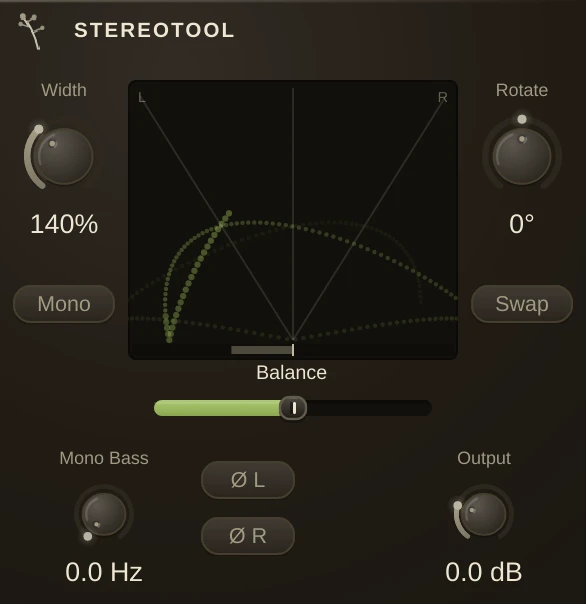
A stereo imaging utility that works in mid/side, with zero latency. Mid is what the two channels share (the centre); side is what they do not (the difference). Splitting a stereo signal into those two parts is what lets you widen an image, mono the bass, or rotate a field without disturbing the rest of the mix.
Stereo in, stereo out. Everything here is surgical rather than colouring - for the colour, put a Console after it.
Parameters
| Width | side level. 0% collapses to mono, 100% leaves the image alone, and it runs to 400%. Above 100% exaggerates whatever the two channels do not share, so it thins the centre as it widens. |
| Balance | left/right level balance, the ordinary pan-style control. |
| Rotation | turns the whole stereo field by an angle, in degrees. Unlike Balance it moves the image rather than just levelling it, so the centre travels with everything else. |
| MonoBass | below this frequency the side is removed, so the low end collapses to mono. 0 is off. The classic "mono maker". |
| PhaseL | inverts the phase of the left channel. |
| PhaseR | inverts the phase of the right channel. |
| Swap | swaps left and right. |
| Mono | collapses the output to mono. |
| Output | output gain, applied last. |
Signal flow
The order is fixed, and knowing it explains most surprises:
| 1 | Phase and Swap |
| 2 | Encode to mid/side |
| 3 | Width and MonoBass act on the side |
| 4 | Decode back to left/right |
| 5 | Rotation, then Balance, then Mono, then Output |
Because Width and MonoBass act on the side, they are the only two controls that change the image itself; the rest move or level it.
Usage
MonoBass around 100-150 Hz is the standard move: it keeps the low end centred and phase-solid on big systems while leaving the top as wide as you like. Set Width after MonoBass, not before, or you will be judging a width the mono-maker is about to take back.
Check Mono constantly, because Width above 100% is exactly the setting that sounds huge in stereo and vanishes in mono - you are boosting the part mono subtracts away. If a stereo source sounds hollow and disappears in mono its channels are already out of phase, so flip one and re-check. A few degrees of Rotation fixes a lopsided recording far more naturally than Balance does.
Notes
Width 0%, Mono on, and MonoBass at maximum are three different routes to a mono signal and are not interchangeable: Width 0% removes the side, Mono sums the output, and MonoBass only collapses below its corner.